MP1582EN PDF Datasheet – Step-Down Converter

Part Number: MP1582EN

Function: 2A, 28V, 1.5MHz, Step-Down Converter

Package: SOIC-8 Pin type

Manufacturer: MPS

Images:MP1582EN pdf converter

Description

The MP1582EN is a high frequency step-down switching regulator with integrated internal high-side, high voltage power MOSFET. It provides 2A output with current mode control for fast loop response and easy compensation.

The wide 4.5V to 28V input range accommodates a variety of step-down applications, including those in automotive systems. A 100µA operational quiescent current allows use in battery-powered applications. High power conversion efficiency over a wide load range is achieved by scaling down the switching frequency at light load condition to reduce the switching and gate driving losses.

Features

• Wide 4.5V to 28V Operating Input Range

• Programmable Switching Frequency up to 1.5MHz

• High-Efficiency Pulse Skipping Mode for Light Loads

• Ceramic Capacitor Stable

• Internal Soft-Start

• Precision Current Limit without a Current Sensing Resistor

Pinouts:
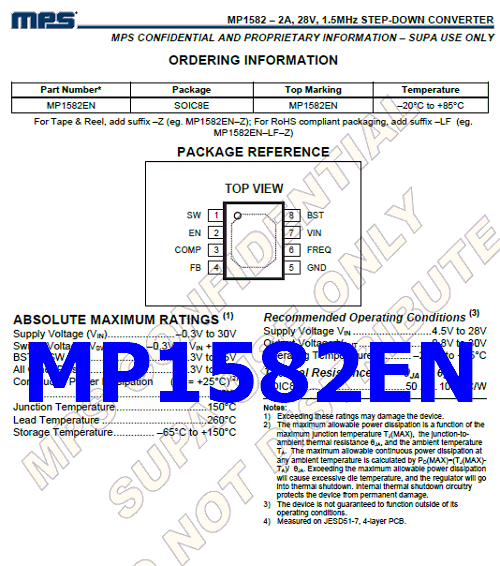
MP1582EN pinout datasheet

Applications:

• Game Machines

• Automotive Systems

• Industrial Power Systems

• Distributed Power Systems

• Printer Systems

• Battery Powered Systems

MP1582EN PDF Datasheet

MP1582EN pdf

KY701F PDF Datasheet – 0.7A, 80V, Silicon Rectifier, Diode

Part Number: KY701F

Function: 0.7A, 80V, Silicon Rectifier, Diode

Manufacturer: Tesla

Images:

KY701F diode rectifier


Description

KY701F is 0.7A, 80V, Silicon Rectifier. It’s Diode.

A silicon rectifier is a type of electronic component used in electrical circuits to convert alternating current (AC) into direct current (DC). It’s a semiconductor device that takes advantage of the properties of silicon, a widely used semiconductor material.

Here’s how a silicon rectifier works:

1. Rectification: Alternating current periodically changes direction, moving back and forth. A rectifier allows current to flow in only one direction, effectively converting AC to DC. It does this by utilizing the properties of semiconductor materials, such as silicon, to create a one-way path for current flow.

2. P-N Junction: A silicon rectifier typically consists of a P-N junction, which is the interface between a region of semiconductor material with an excess of positive charge carriers (P-type) and a region with an excess of negative charge carriers (N-type). When these two regions are brought together, it forms a diode, which acts as a one-way valve for electric current.

3. Half-Wave and Full-Wave Rectification: Silicon rectifiers can be used in both half-wave and full-wave rectification circuits. In a half-wave rectifier, only one half of the AC waveform is allowed to pass through, resulting in a pulsating DC output. In a full-wave rectifier, both halves of the AC waveform are used, resulting in a smoother DC output.

KY701F pdf rectifier diode

KY701F PDF Datasheet

Related articles across the web