ATMEGA128-16AU Datasheet – 8-bit Microcontroller – ATMEL

Part Number: ATMEGA128-16AU

Function : 8-bit Microcontroller with 128K Bytes In-System Programmable Flash

Package: 64-lead TQFP

Manufacturer: ATMEL Corporation

Image
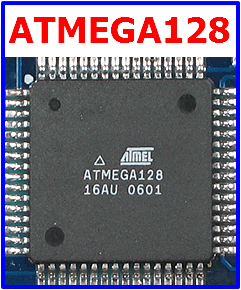
ATMEGA128-16AU-microcontroller

Description

The high-performance, low-power Atmel 8-bit AVR RISC-based microcontroller combines 128KB of programmable flash memory, 4KB SRAM, a 4KB EEPROM, an 8-channel 10-bit A/D converter, and a JTAG interface for on-chip debugging. The device supports throughput of 16 MIPS at 16 MHz and operates between 4.5-5.5 volts.

By executing instructions in a single clock cycle, the device achieves throughputs approaching 1 MIPS per MHz, balancing power consumption and processing speed.

Pinout
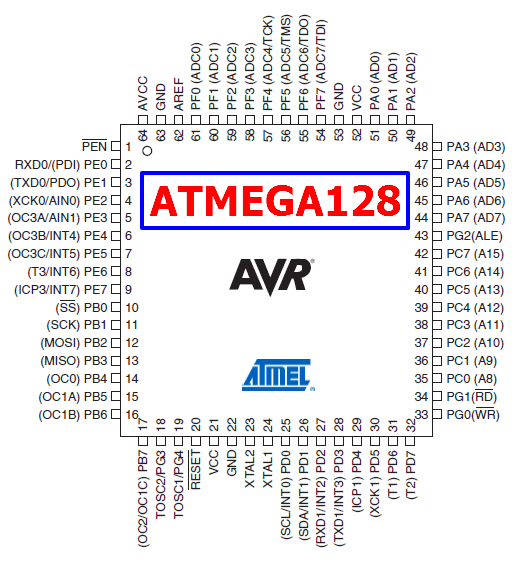
ATMEGA128-16AU-datasheet-pinout


Features

1. High-performance, Low-power Atmel®AVR®8-bit Microcontroller

2. Advanced RISC Architecture
(1) 133 Powerful Instructions – Most Single Clock Cycle Execution
(2) 32 x 8 General Purpose Working Registers + Peripheral Control Registers
(3) Fully Static Operation
(4) Up to 16MIPS Throughput at 16MHz
(5) On-chip 2-cycle Multiplier

3. High Endurance Non-volatile Memory segments
(1) 128Kbytes of In-System Self-programmable Flash program memory
(2) 4Kbytes EEPROM
(3) 4Kbytes Internal SRAM


Official Homepage: http://www.atmel.com/devices/ATMEGA128.aspx

ATMEGA128-16AU Datasheet


Related articles across the web

PIC16C661 Datasheet PDF – 8-Bit EPROM Microcontroller

Part Number: PIC16C661

Function: 8-Bit EPROM Microcontroller with analog comparator

Package: DIP 40 Pin Type

Manufacturer: Microchip Technology

Pinouts:

PIC16C661 datasheet


Description

PIC16C64X & PIC16C661 devices are 28-pin and 40-pin EPROM-based members of the versatile PIC16CXXX family of low-cost, high-performance, CMOS, fully-static, 8-bit microcontrollers. All PIC16/17 microcontrollers employ an advanced RISC architecture. The PIC16CXXX family has enhanced core features, eight-level deep stack, and multiple internal and external interrupt sources. The separate instruction and data buses of the Harvard architecture allow a 14-bit wide instruction word with the separate 8-bit wide data. The two-stage instruction pipeline allows all instructions to execute in a single-cycle, except for program branches (which require two cycles). A total of 35 instructions (reduced instruction set) are available. Additionally, a large register set gives some of the architectural innovations used to achieve a very high performance.

PIC16CXXX microcontrollers typically achieve a 2:1 code compression and a 4:1 speed improvement over other 8-bit microcontrollers in its class. The PIC16C641 has 128 bytes of RAM and the PIC16C642 has 176 bytes of RAM. Both devices have 22 I/O pins, and an 8-bit timer/counter with an 8-bit programmable prescaler. In addition, they have two analog comparators with a programmable on-chip voltage reference module. Program Memory has internal parity error detection circuitry with a Parity Error Reset. The comparator module is ideally suited for applications requiring a low-cost analog interface (e.g., battery chargers, threshold detectors, white goods controllers, etc.).


Features

1. Power-on Reset (POR)
2. Power-up Timer (PWRT) and Oscillator Start-up Timer (OST)
3. Brown-out Reset
4. Watchdog Timer (WDT) with its own on-chip RC oscillator for reliable operation
5. Programmable code protection
6. Power saving SLEEP mode
7. Selectable oscillator options
8. Serial in-circuit programming (via two pins)


Other data sheets are available within the file: PIC16C641-04/P, PIC16C641-04/SO, PIC16C641-04E/JW

PIC16C661 Datasheet PDF Download


PIC16C661 pdf