ATtiny20 Datasheet PDF – 8-Bit AVR Microcontroller

Part Number: ATtiny20

Function: 8-bit AVR Microcontroller with 2K Bytes In-System Programmable Flash

Package : 12-ball(WLCSP), 14-lead(SOIC, TSSOP), 15-ball(UFBGA), 20-pad(VQFN) Pin type

Manufacturer: Atmel Corporation ( ATmel -> Microchip )

Image :

ATtiny20-datasheet-pinout

Description

ATtiny20 is a low-power CMOS 8-bit microcontroller based on the compact AVR enhanced RISC architecture. By executing powerful instructions in a single clock cycle, the ATtiny20 achieves throughputs approaching 1 MIPS per MHz allowing the system designer to optimize power consumption versus processing speed.

The AVR core combines a rich instruction set with 16 general purpose working registers and system registers. All registers are directly connected to the Arithmetic Logic Unit (ALU), allowing two independent registers to be accessed in one single instruction executed in one clock cycle. The resulting architecture is compact and code efficient while achieving throughputs up to ten times faster than conventional CISC microcontrollers.


Pinout
ATtiny20-AVR-Microcontroller
Features

1. 2K bytes of in-system programmable Flash
2. 128 bytes of SRAM
3. Twelve general purpose I/O lines
4. 16 general purpose working registers
5. An 8-bit Timer/Counter with two PWM channels
6. A 16-bit Timer/Counter with two PWM channels
7. Internal and external interrupts
8. An eight-channel, 10-bit ADC
9. A programmable Watchdog Timer with internal oscillator
10. A slave two-wire interface
11. A master/slave serial peripheral interface
12. An internal calibrated oscillator
13. Four software selectable power saving modes

Official Homepage: https://www.microchip.com/wwwproducts/en/ATtiny20

Ordering Code :

ATtiny20-UUR, ATtiny20-SSU, ATtiny20-SSUR, ATtiny20-XU, ATtiny20-XUR, ATtiny20-CCU

ATtiny20 PDF Datasheet Download


Posts related to ‘ 8-Bit AVR Microcontroller ‘

Part number Description
ATmega168 8-bit AVR Microcontroller – ATMEL
ATmega32A ATmega32A Datasheet Download – 8-Bit AVR Microcontroller
ATmega328 8-bit AVR Microcontrollers
ATtiny85 8-bit AVR Microcontroller – ATMEL
AT90USB162 8-bit AVR Microcontrollers – Microchip
ATmega328 8-bit AVR RISC-based Microcontroller
ATmega328P ATmega328P PDF – 8-bit AVR RISC-based Microcontroller
ATMEGA8 8-bit AVR Microcontroller – ATMEL
ATmega328P 8-bit AVR Microcontrollers
ATMEGA32U4 8-Bit AVR Microcontroller – ATMEL


USBASP Pinout – USBASP AVR Programmer

The USBasp is a popular USB-based programmer for Atmel (now Microchip) AVR microcontrollers. It is an open-source hardware and firmware project originally developed by Thomas Fischl. The device allows users to program AVR microcontrollers via ISP (In-System Programming) interface using a standard USB connection, without requiring special hardware like expensive development programmers.

AC-PG-USBASP USBASP AVR Programmer

AC-PG-USBASP

USBasp is a USB in-circuit programmer for Atmel AVR controllers. It simply consists of an ATMega8 and a few passive components. The programmer uses a firmware-only USB driver, no special USB controller is needed.

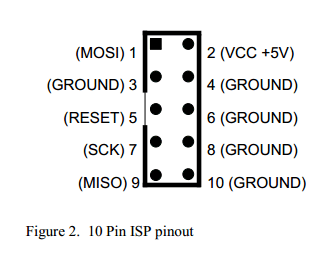
USBASP Pinout

USBASP Pinout

Features

1. Interface: USB 2.0 (Full Speed)

2. Target Connection: 10-pin or 6-pin ISP header

3. Supported Devices: Almost all AVR microcontrollers with ISP interface (e.g., ATmega, ATtiny families)

4. Programming Voltage: Supports both 5V and 3.3V targets (via jumper or regulator)

5. Firmware Upgradeable: Programmer firmware itself can be updated via another USBasp

6. Clock Frequency Options: Slow SCK option for programming targets with low clock speeds (<1.5 MHz)

7. Driver Support: Works with libusb drivers on Windows/Linux/macOS

8. Open Source: Both hardware schematics and firmware are freely available

Some of the key features include:

a.  Works under multiple platforms. Linux, Mac OS X and Windows are tested,

b.  Programming speed is up to 5kBytes/sec, and

c.  SCK option to support targets with low clock speed (< 1,5MHz).


IPS2 – 6 pin SIL

The 6 pin ISP connection provides an alternative to the standard 10 pin IDC connector. The board provides 6 holes where a single row header, polarised header or other connector can be mounted.

The pinout is shown in Figure 3.

1 (VCC +5V)
2 (MOSI)
3 (SCK)
4 (MISO)
5 (RESET)
6 (GROUND)

Applications

1. Flashing Bootloaders into Arduino boards (e.g., ATmega328P)

2. Programming AVR microcontrollers directly (without bootloader)

3. Updating firmware on custom AVR-based embedded systems

4. Educational use in learning microcontrollers and embedded systems

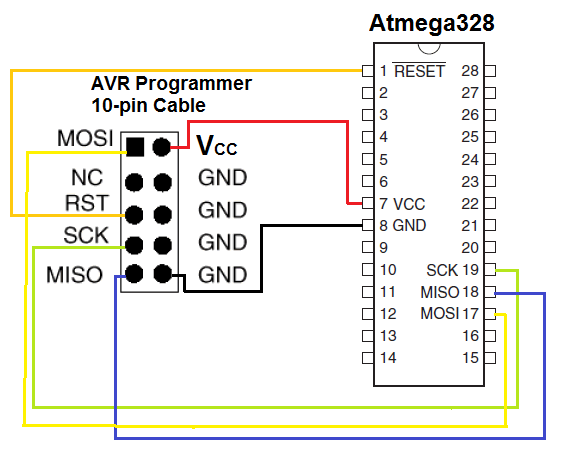
USBASP Atmega Circuit

USBASP Atmega Circuit

Supported Microcontrollers

AT89S8252  AT90S2343(L)  ATMEGA168(V)  ATMEGA649(V)
ATTiny12(L)  AT90S1200(L)  ATMEGA169(V)  ATMEGA6490(V)
ATTiny13(V)  AT90S8515(L)  ATMEGA169P(V)  ATMEGA128(L)
ATTiny15(L)  AT90S8535(L)  ATMEGA32(L)  ATMEGA1280(V)
ATTiny24(V)  ATMEGA48(V)  ATMEGA324(V)  ATMEGA1281(V)
ATTiny25(V)  ATMEGA8(L)  ATMEGA325(V)  ATMEGA2560(V)
ATTiny26(L)  ATMEGA88(V)  ATMEGA3250(V)  ATMEGA2561(V)
ATTiny2313(V)  ATMEGA8515(L)  ATMEGA329(V)  AT90CAN32
ATTiny44(V)  ATMEGA8535(L)  ATMEGA3290(V)  AT90CAN64
ATTiny45(V)  ATMEGA16(L)  ATMEGA64(L)  AT90CAN128
ATTiny84(V)  ATMEGA162(V)  ATMEGA640(V)  AT90PWM2(B)
ATTiny85(V)  ATMEGA163(L)  ATMEGA644(V)  AT90PWM3(B)
AT90S2313(L)  ATMEGA164(V)  ATMEGA645(V)
AT90S2323(L)  ATMEGA165(V)  ATMEGA6450(V)

Datasheet Manual Download:

USBASP pdf