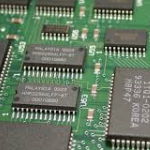
25Q32FVS1G Datasheet – 32M-bit Serial Flash Memory – Winbond

Part Number: 25Q32FVS1G, Correct Number :  W25Q32FVSSIG, Marking : 25Q32FVSIG

Function: 32M-bit Serial Flash Memory

Package: SOIC-8 208-mil Type

Manufacturer: Winbond Electronics Corporation

Image
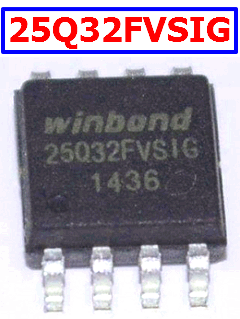
Winbond 25Q32FVS1G Datasheet

Description

The Winbond 25Q32FVS1G (32M-bit) Serial Flash memory provides a storage solution for systems with limited space, pins and power. The 25Q series offers flexibility and performance well beyond ordinary Serial Flash devices. They are ideal for code shadowing to RAM, executing code directly from Dual/Quad SPI (XIP) and storing voice, text and data. The device operates on a single 2.7V to 3.6V power supply with current consumption as low as 4mA active and 1μA for power-down. All devices are offered in space-saving packages.

Pinout
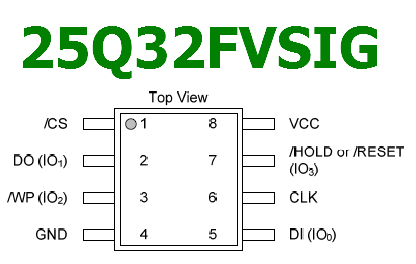
25Q32FVS1G Pinout

Features

Highest Performance Serial Flash

1. 104MHz Single, Dual/Quad SPI clocks
2. 208/416MHz equivalent Dual/Quad SPI
3. 50MB/S continuous data transfer rate
4. More than 100,000 erase/program

Advanced Security Features

1. Software and Hardware Write-Protect
2. Power Supply Lock-Down and OTP protection
3. Top/Bottom, Complement array protection
4. Individual Block/Sector array protection
5. 64-Bit Unique ID for each device
6. Discoverable Parameters (SFDP) Register
7. 3X256-Bytes Security Registers with OTP locks
8. Volatile & Non-volatile Status Register Bits


25Q32FVS1G Datasheet

25Q32FVS1G pdf


Other data sheets are available within the file: W25Q32FVSSIP, 25Q32FVSIP
Related articles across the web

IEEE1394 Datasheet – Connector System for Serial Bus – Tyco

Part Number: IEEE1394

Function: Connector System for IEEE 1394 Serial Bus

Manufacturer: Tyco Electronics, NXP

Image :

IEEE1394 image

Description

IEEE 1394 is an interface standard for a serial bus for high-speed communications and isochronous real-time data transfer. It was developed in the late 1980s and early 1990s by Apple, which called it FireWire. The 1394 interface is comparable to USB though USB has more market share.[1] Apple first included FireWire in some of its 1999 Macintosh models, and most Apple Macintosh computers manufactured in the years 2000 – 2011 included FireWire ports. However, in 2011 Apple began replacing FireWire with the Thunderbolt interface and, as of 2014, FireWire has been replaced by Thunderbolt on new Macs.[2] The 1394 interface is also known by the brand i.LINK (Sony), and Lynx (Texas Instruments). IEEE 1394 replaced parallel SCSI in many applications, because of lower implementation costs and a simplified, more adaptable cabling system. The 1394 standard also defines a backplane interface, though this is not as widely used.

IEEE 1394 was the High-Definition Audio-Video Network Alliance (HANA) standard connection interface for A/V (audio/visual) component communication and control.[3] (HANA was dissolved in September 2009 and the 1394 Trade Association assumed control of all HANA-generated intellectual property.) FireWire is also available in wireless, fiber optic, and coaxial versions using the isochronous protocols.


IEEE1394 Datasheet

Download : IEEE1394.PDF


Related articles across the web