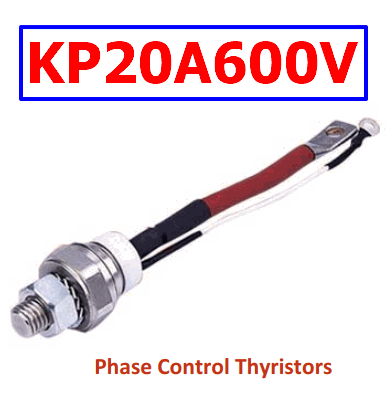
KP20A600V PDF Datasheet – Phase Control Thyristor

Part Number: KP20A600V

Function: Phase Control Thyristor

Manufacturer: Jeenda

Images:KP20A600V thyristor
Description

KP20A600V is 20A, Phase Control Thyristor.

A Phase Control Thyristor, also known as a Silicon-Controlled Rectifier (SCR), is a type of semiconductor device used in power electronics for controlling high-power loads by conducting current in only one direction. It is a four-layer, three-junction semiconductor device with three terminals: an anode, a cathode, and a gate.

The basic operation of a phase control thyristor involves controlling the time at which it starts to conduct current during each AC half-cycle. This allows the thyristor to control the power delivered to the load and is commonly used for applications that require varying the output voltage or current to control the speed of motors, regulate power to heaters, and dim lights in lighting circuits.

Specification:

1. Hermetic metal case with ceramic insulator

2. Hermetic glassͲmetal seal

3. Conform to partial national standard JB/T8949.2-1999

4. In accordance with IEC international electrical committee standard


Typicla applications :

1. DC motor controls

2. Controlled DC power supplies

3. AC switch and thermal control

4. Synchronous motor excitation

Phase control thyristors find applications in various power control and conversion systems, including motor drives, temperature control systems, lamp dimmers, and AC power regulators, to name a few. Their ability to handle high currents and voltages makes them suitable for power electronics applications that require precise control over the flow of power.

KP20A600V PDF Datasheet

Related articles across the web

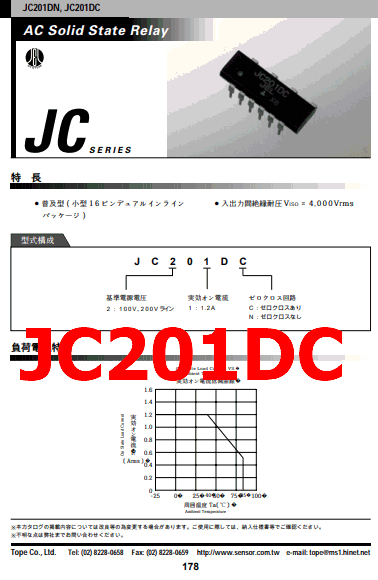
JC201DC PDF Datasheet – AC Solid State Relay

Part Number: JC201DC

Function: AC Solid State Relay

Package: DIP 16 Pin Type

Manufacturer: Jelsystem ( http://www.jelsystem.co.jp )

Images:JC201DC pdf relay

Description

JC201DC is AC Solid State Relay. An AC Solid State Relay (AC SSR) is an electronic device used for switching alternating current (AC) loads without the need for mechanical contacts, like those found in traditional electromechanical relays. Solid state relays are more reliable, have faster switching speeds, and offer longer lifetimes compared to their mechanical counterparts.

AC SSRs use semiconductor devices, typically thyristors (also known as SCR – Silicon Controlled Rectifiers) or triacs, to control the switching of AC loads. These devices can handle high voltage and current levels, making them suitable for a wide range of applications.

The operation of an AC SSR involves using a low-power control signal, usually from a microcontroller or digital logic circuit, to trigger the internal semiconductor device, which then allows current to flow through the AC load circuit. AC SSRs often include features like zero-crossing detection, which helps minimize inrush current and reduces electromagnetic interference (EMI) by ensuring that the relay is turned on and off at points where the AC voltage waveform crosses zero.

Features

1. Dielectric strength between input and output VISO = 4,000Vrms.

Pinouts:
JC201DC datasheet pinout

JC201DC PDF Datasheet

Related articles across the web