What is BD139? 80V, 1.5A, NPN Transistor ( PDF )

This post explains for the semiconductor BD139.

What is BD139?

This transistor is housed in a TO-126 package and has a maximum collector current of 1.5A, a maximum collector-emitter voltage of 80V, and a maximum power dissipation of 12.5W.

Low noise and high gain characteristics, which make it ideal for use in audio amplifiers and other low-level signal amplification applications. Additionally, its low saturation voltage and fast switching speed make it suitable for use in high-speed switching circuits.

Part Number: BD139, BD137, BD135

Function: 80V, 1.5A, NPN Epitaxial Silicon Transistor

Package: TO-126 3L Type

Manufacturer: Fairchild Semiconductor

Image

BD139 image

Features

1. NPN bipolar junction transistor
2. Low power, medium voltage device
3. Maximum collector current of 1.5A
4. Maximum collector-emitter voltage of 80V
5. Maximum power dissipation of 12.5W
6. Housed in a TO-126 package
7. Low noise and high gain characteristics
8. Low saturation voltage and fast switching speed
9. Suitable for a wide range of applications
10. Complement to BD136, BD138 and BD140 respectively

Advantages Vs Disadvantages

Advantages of BD139:

1. Versatile and widely used in the electronics industry
2. Reliable and cost-effective
3. Ideal for low-level signal amplification applications
4. Suitable for use in high-speed switching circuits
5. Readily available

Disadvantages:

1. Maximum power dissipation of 12.5W may not be sufficient for some high-power applications

2. Maximum collector-emitter voltage of 80V may not be suitable for some high-voltage applications
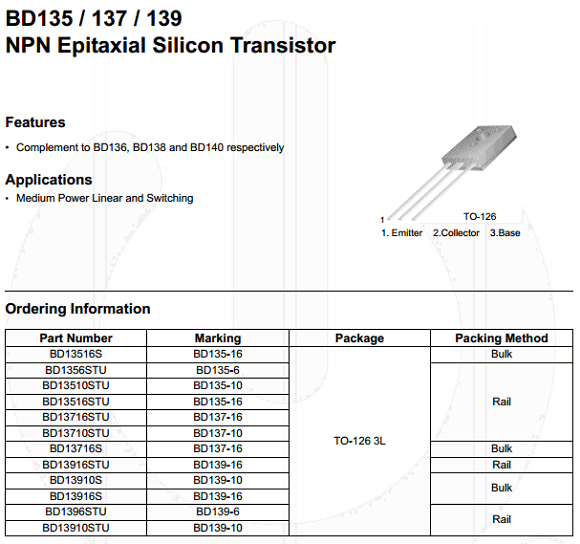
 

BD139 datasheet

Part Number  ->   Marking
BD13516S  ->  BD135-16
BD1356STU  ->  BD135-6
BD13510STU  ->  BD135-10
BD13516STU  ->  BD135-16
BD13716STU  ->  BD137-16
BD13710STU  ->  BD137-10
BD13716S  ->  BD137-16
BD13916STU  ->  BD139-16
BD13910S  ->  BD139-10
BD13916S  ->  BD139-16
BD1396STU  ->  BD139-6
BD13910STU  ->  BD139-10

Absolute maximum ratings ( Ta=25°C )

1. Collector to Base Voltage: Vcbo = 80 V

2. Collector to Emitter Voltage: Vceo = 80 V

3. Emitter to Base Voltage: Vebo = 5 V

4. Collector Current: Ic = 1.5 A

5. Collector Dissipation : Pc = 12.5 W

6. Junction Temperature: Tj = 150°C

7. Storage Temperature: Tsg = -65 ~ +150°C


Applications:

1. Medium Power Linear and Switching


BD139 Datasheet

BD139 fairchild pdf


Related articles across the web

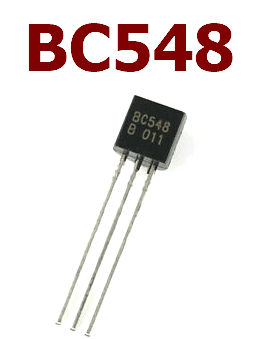
BC548 Transistor – NPN, 30V, 100mA, TO-92, Amplifier ( PDF )

What is BC548 Transistor?

This is 30V, 100mA, NPN Transistor. It is a popular and widely used bipolar junction transistor (BJT) with NPN polarity.

1. This is an NPN transistor, meaning it has a negative-positive-negative structure with a P-type layer sandwiched between two N-type layers.

2. It has a maximum voltage rating of 30V and a maximum current rating of 100mA, making it suitable for low-power applications.

3. It has a high current gain (hFE) of up to 800, which makes it useful for applications where high amplification is required.

The Part Number is BC548.

The function of this transistor is General Purpose Amplifier.

Manufacturer: Motorola

See the preview image and the BC548 datasheet file for more information.

Image

BC548 transistor

Description

This is 30V, 0.1A, NPN Silicon Epitaxial Planar Transistor. This is commonly used in low-power amplifiers, signal processing circuits, and switching circuits. It is also used in oscillator circuits, voltage regulators, and LED drivers.

Advantages Vs Disadvantages

1. It is a low-cost transistor that is readily available and widely used in electronic circuits.

2. Its high current gain makes it useful for applications where amplification is needed, such as in audio amplifiers and signal amplifiers.

3. It is compatible with a wide range of voltage levels and can be used in a variety of electronic circuits.

Disadvantages:

1. It is a low-power transistor and cannot handle high current or voltage levels, limiting its use in high-power applications.

2. Its maximum frequency response is limited to around 300 MHz, which makes it unsuitable for high-frequency applications such as radio frequency circuits.

3. It has a relatively low collector-emitter breakdown voltage (VCEO) of 30V, which limits its use in circuits that require higher voltage levels.


Applications:

1. General Transistor.

BC548 pinout

BC548 datasheet

Absolute maximum ratings ( Ta=25°C )

1. Collector to Base Voltage: Vcbo = 30 V

2. Collector to Emitter Voltage: Vceo = 30 V

3. Emitter to Base Voltage: Vebo = 6 V

4. Collector Current: Ic = 100 mA

5. Total Dissipation : Pc = 625 MW

6. Junction Temperature: Tj = 150°C

7. Storage Temperature: Tsg = -55 ~ +150°C

BC548 Transistor Datasheet

BC548 pdf


BC548 vs BC547

Similar features and reference parts

Related articles across the web