What is 2SB861?
This is a PNP bipolar junction transistor (BJT) designed for general-purpose amplifier and switching applications.
Part Number: 2SB861
Function: -150V, -2A, Silicon Power PNP Tranistor
Package: TO-220AB Type
Manufacturer: Hitachi, Renesas Electronics
Image and Pinouts:
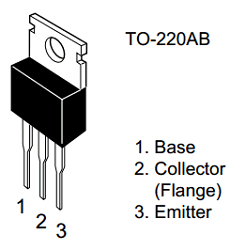
This transistor has three pins: emitter, base, and collector.
Description
The 2SB861 is Silicon PNP Triple Diffused Transistor. It is commonly used in audio amplifier circuits, voltage regulators, and switching circuits. It can also be used in other general-purpose applications where a PNP transistor is required.
The operation of a PNP transistor is based on the biasing of its three layers: the emitter, base, and collector. The emitter is connected to the positive power supply, the base is the control terminal, and the collector is connected to the load or circuit.
When a small current flows into the base terminal, it controls a larger current flowing between the emitter and collector. The transistor amplifies the input signal and can be used to switch larger currents on and off in various electronic circuits.
Silicon PNP transistors offer advantages such as high gain, low noise, and good thermal stability. They are widely used in many applications, including audio amplifiers, power supplies, voltage regulators, and digital logic circuits.
Advantages Vs Disadvantages
Advantages:
1. High voltage and current handling capabilities
2. Low saturation voltage, which reduces power dissipation and improves efficiency in switching applications
Disadvantages:
1. Limited maximum current rating, which makes it unsuitable for high power applications
2. Relatively low maximum frequency rating, which makes it unsuitable for high-speed applications
3. Limited gain bandwidth product, which limits its use in high-frequency amplification circuits
Absolute maximum ratings ( Ta=25°C )
1. Collector to Base Voltage: Vcbo = -200 V
2. Collector to Emitter Voltage: Vceo = -150 V
3. Emitter to Base Voltage: Vebo = -6 V
4. Collector Current: Ic = -2 A
5. Total Dissipation : Pc =1.8 W
6. Junction Temperature: Tj = 150°C
7. Storage Temperature: Tsg = -55 ~ +150°C
Applications:
1. Low frequency power amplifier color TV vertical deflection output complementary pair with 2SD1138
Related Posts
Other data sheets are available within the file: B861
2SB861 Datasheet PDF Download