What is 1N4733A? – 5.1V, 1W, Zener Diode, Rectifier ( PDF )

What is 1N4733A?

This is a type of 5.1V, Zener diode that is commonly used in electronic circuits for voltage regulation and voltage reference.

This Zener diode has a number of features that make it popular in electronic circuits, including its low cost, small size, and high reliability. It is widely available and can be used in a variety of circuits such as voltage regulators, voltage references, and power supplies.

Part Number: 1N4733A

Function: 5.1V, 1W, Zener Diode

Package: DO-41 Glass case

Manufacturer: Fairchild Semiconductor

Image and pinout

1N4733A datasheet


Description

This is a complete series of 1 Watt Zener diode with limits and excellent operating characteristics that reflect the superior capabilities of silicon-oxide passivated junctions. All this in an axial-lead hermetically sealed glass package that offers protection in all common environmental conditions.

DO-41 Glass case, Tolerance = 5%

Advantages

1. Low cost and widely available
2. Small size makes it suitable for compact circuits
3. High reliability and long lifespan
4. Provides a stable voltage reference or voltage regulation


Disadvantages

1. Limited range of breakdown voltages available
2. Can experience thermal runaway if not used properly
3. Not suitable for high-power applications

Specifications

1. Vz – Zener Voltage : 5.1 V
2. Mounting Style :  Through Hole
3. Package / Case :  DO-41-2
4. Pd – Power Dissipation :  1 W
5. Voltage Tolerance : 5 %
6. Zener Current :  10 uA
7. Zz – Zener Impedance :  7 Ohms
8. Minimum Operating Temperature : – 65 °C
9. Maximum Operating Temperature : + 200 °C

Other data sheets are available within the file:

1N4728A, 1N4729A, 1N4730A, 1N4731A, 1N4732A

1N4733A Datasheet PDF Download


1N4733A pdf

Related articles across the web

What is BAS28? 85V, 0.2A, Silicon Switching Diode, Rectifier

What is BAS28?

It is a high-speed switching diode commonly used in electronic circuits for rectification, signal processing, and switching applications. It is a small signal Schottky diode that provides fast switching and low forward voltage drop.

Part Number: BAS28, Marking : JTs

Function: 85V, 200mA, Silicon Switching Diode Array

Package: SOT143 Type

Manufacturer: Infineon Technologies

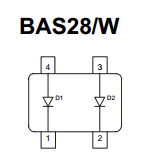
Image and Pinouts:

BAS28 datasheet


Description

This is 85V, 200mA, Silicon Switching Diode, Rectifier.

Advantages Vs Disadvantages

Advantages:

1. High-speed switching: Fast switching due to its low reverse recovery time and low capacitance

2. Low forward voltage drop: The low forward voltage drop reduces power dissipation and improves circuit efficiency

3. Small size: The small size makes it ideal for use in space-constrained applications

4. Wide operating temperature range: Operate in a wide range of temperatures, making it suitable for use in harsh environments

Disadvantages:

1. Low reverse voltage rating: Maximum reverse voltage rating of 85V, which may limit its use in high-voltage applications

2. Low current handling: It is designed for low current applications and may not be suitable for high current requirements

3. Limited reverse recovery capability: It has a limited reverse recovery capability and may not be suitable for applications with high di/dt rates

Features

1. For high-speed switching applications

2. Electrical insulated diodes

3. Pb-free (RoHS compliant) package

4. Qualified according AEC Q101


Specifications:

1. Peak Reverse Voltage : Vrm = 85 V

2. Max Surge Current : Ifs = 4.5 A

3. If – Forward Current : 200 mA

4. Configuration : Dual

5. Recovery Time : 4 ns

6. Vf – Forward Voltage : 1.25 V

7. Ir – Reverse Current : 100 nA


FAQ:

Q1: What is the difference between a Schottky diode and a regular diode?
A1: A Schottky diode has a lower forward voltage drop than a regular diode, which makes it useful in applications where power dissipation is a concern. Schottky diodes also have a faster switching speed and lower reverse recovery time.

Q2: What is reverse recovery time?
A2: Reverse recovery time is the time it takes for a diode to switch from conducting in the forward direction to blocking in the reverse direction. This time delay can cause issues in high-frequency switching applications, which is why Schottky diodes are often used instead.

BAS28 Datasheet PDF


BAS28 pdf

Other data sheets are available within the file: BAS28W

Related articles across the web