What is C828? – 25V, 50mA, NPN Transistor – Toshiba

What is C828?

This is a widely used NPN bipolar junction transistor (BJT) that is commonly used in electronic circuits for amplification and switching applications. Its low cost, high current gain, and wide operating temperature range make it particularly suitable for use in low-power and low-cost applications. However, its limited voltage and current handling capabilities and low frequency response may limit its use in more demanding applications.

Part Number: C828, 2SC828

Function: 25V, 50mA, NPN Transistor

Package: TO-92 Type

Manufacturer: Toshiba

Pinouts :
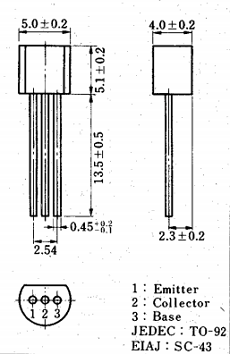
C828 pinout

Description

This is NPN Silicon Epitaxial Planar Transistor. The C828 is a versatile transistor that can be used in a wide range of electronic circuits for amplification and switching purposes. Its low cost, high current gain, and wide operating temperature range make it particularly suitable for use in low-power and low-cost applications.

Advantages Vs Disadvantages

Advantages:

1. Low cost: Low-cost transistor that is widely available and affordable.

2. High current gain: High current gain, which makes it suitable for use in low-power amplifier circuits.

3. Wide operating temperature range: It can operate within a temperature range of -55°C to +150°C, making it suitable for use in a wide range of environments.

4. Easy to use: The transistor is housed in a small TO-92 package, which makes it easy to incorporate into electronic circuits.

Disadvantages:

1. Low voltage and current handling capabilities: The C828 has a maximum collector-base voltage of 25V and a maximum collector current of 50mA, which limits its use in circuits that require higher voltage and current handling capabilities.

2. Limited frequency response: The transistor has a low cutoff frequency, which limits its use in high-frequency applications.

3. Temperature sensitivity: The transistor’s performance can be affected by changes in temperature, which can impact circuit performance.

C828 Electronics Charateristics
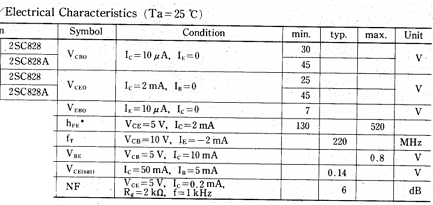
C828 datasheet

Absolute maximum ratings ( Ta=25°C )

1. Collector to Base Voltage: Vcbo = 30 V

2. Collector to Emitter Voltage: Vceo = 25 V

3. Emitter to Base Voltage: Vebo = 7 V

4. Collector Current: Ic = 50 mA

5. Collector Dissipation : Pc = 400 mW

6. Junction Temperature: Tj = 150°C

7. Storage Temperature: Tsg = -55 ~ +150°C

C828 Datasheet PDF Download

C828 pdf


Other data sheets are available within the file: 2SC828, 2SC828A, C828A
Related articles across the web

K2611 Datasheet – 9A, 900V, N-Ch, MOSFET – Toshiba

What is K2611?

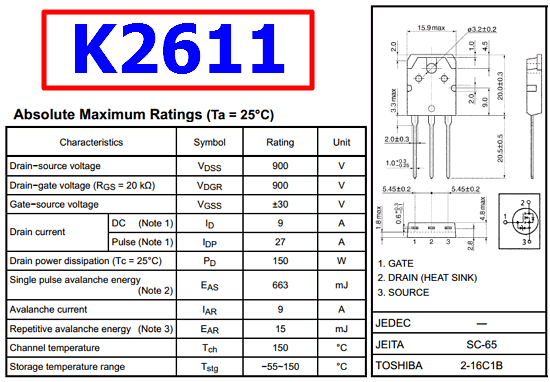
It has a maximum voltage rating of 900 volts and a maximum current rating of 9 amperes.
The K2611 is a high voltage, high power MOSFET transistor that is commonly used in power supplies, audio amplifiers, and motor control circuits.

Part Number: 2SK2611

Function: 900V, 9A, N-Channel MOSFET

Package: TO-3P Type

Manufacturer: Toshiba

Image
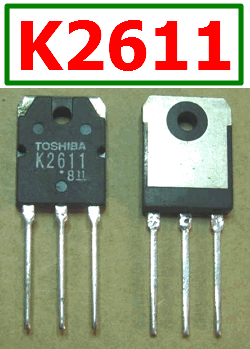
K2611 mosfet

Description

This is 9A, 900V, Silicon N-Channel MOS Type (π−MOSIII) Field Effect Transistor. This parts have high voltage and high power capabilities and low on-resistance for efficient switching. It also ensures fast switching speeds for high-frequency applications.

Features

1. Low drain−source ON resistance  : RDS (ON)= 1.1 Ω(typ.)

2. High forward transfer admittance  : |Yfs| =7.0 S (typ.)

3. Low leakage current  : IDSS= 100 μA (max) (VDS= 720 V)

4. Enhancement−mode : Vth= 2.0~4.0 V (VDS= 10 V, ID= 1 mA)

Pinout

K2611 datasheet pdf pinout

Advantages Vs Disadvantages

Advantages:

1. High voltage and power ratings make it suitable for high power applications
2. Low on-resistance results in less power dissipation and higher efficiency
3. Fast switching speed allows for high frequency operation
4. Low gate drive requirements simplify the control circuitry

Disadvantages:

1. The K2611 may be more expensive than lower voltage or lower power MOSFETs due to its high specifications
2. The high voltage rating may require additional safety precautions when working with the device
3. The high power rating may result in the need for additional heat sinking or cooling measures to prevent overheating

Applications:

1. DC-DC Converter, Relay Drive and Motor Drive


FAQs

Q1: What is the difference between a MOSFET transistor and a regular transistor?

A1: A MOSFET transistor operates by controlling the voltage applied to a gate electrode, whereas a regular transistor controls the current flowing through a base electrode. MOSFETs typically have higher input impedance and faster switching speeds than regular transistors.

Q2: How do I protect a MOSFET transistor from overvoltage or overcurrent?

A2: To protect a MOSFET transistor from overvoltage, a voltage clamping device such as a zener diode or TVS diode can be used. To protect against overcurrent, a fuse or current limiting device can be used. Careful consideration of the device’s specifications and the application’s requirements is essential for effective protection.


K2611 Datasheet


Related articles across the web